 Today · World Post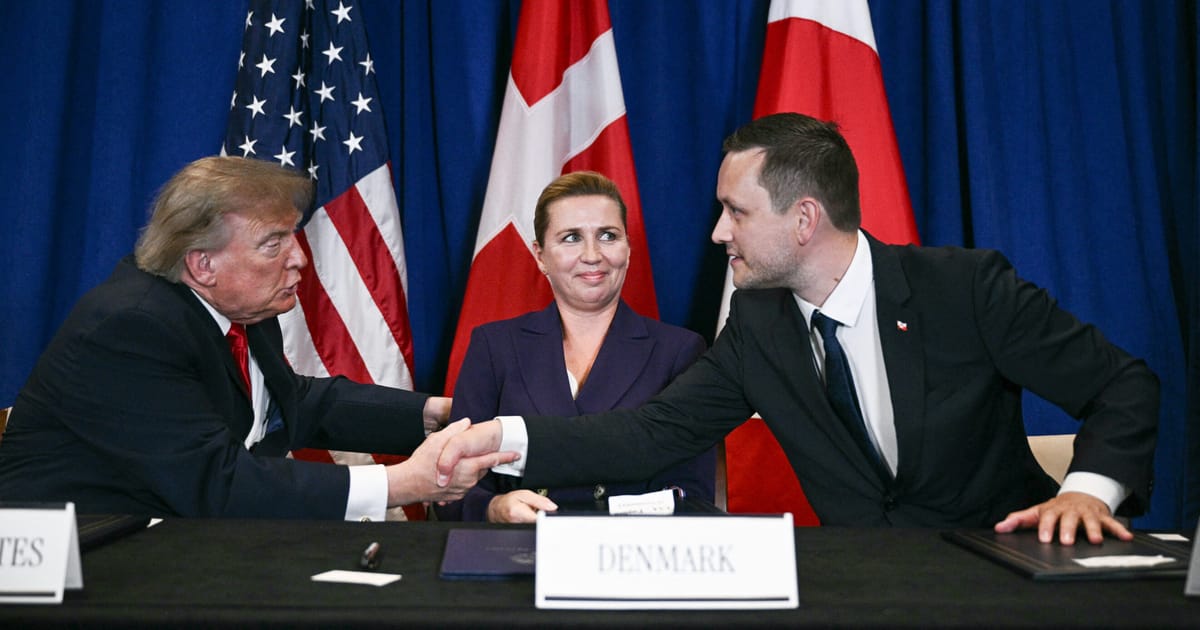
News Politics What sort of promises has the U.S. president made on future security arrangements for Greenland? And will they last? Copy Link Copied Share via email Share on X Share on WhatsApp Share on LinkedIn US President Donald Trump shakes hands with Greenland's Prime Minister Jens-Frederik Nielsen as Denmark's Prime Minister Mette Frederiksen looks on during the signing ceremony for their trilateral security agreement in New York on Sept. 22, 2026. | Brendan Smialowski/AFP via Getty Images September 23, 2026 4:00 am CET Eight months after Donald Trump almost destroyed NATO by threatening to annex Greenland — by force, if necessary — he signed what he called a “fantastic” new deal that would give the U.S. all the control and military access it needs over the Danish territory.
European allies were so alarmed by Trump’s apparent determination to take the territory at the start of the year — and his threat of 25% tariffs on anyone who got in his way — that they began talking about a future for the West without America. In many ways, the transatlantic relationship has not been the same since. Tuesday’s agreement on security in the Arctic and North Atlantic, signed at the United Nations by Trump and the prime ministers of Greenland and Denmark, ends the dispute.
But what exactly is in the deal? Who will pay for it? And who are the winners and losers from months of high-stakes talks?
Here’s POLITICO’s guide: What exactly is the deal? This new agreement, which still needs ratification by Danish and Greenlandic lawmakers, is not, in fact, completely new. Instead, it sets out to “amend and supplement” an earlier deal between the U.S. and Denmark dating back to 1951.
Many experts have been saying for months that this earlier agreement gave Trump most of what he said he wanted in terms of more or less unfettered freedom to set up military bases and police the region’s security. One key difference this time is that Greenland itself is a signatory. What is in the deal?
The opening part of the text reaffirms the signatories’ commitments to abide by international law, respect Danish territory, fulfill NATO’s responsibilities, and uphold the rights of Greenlanders. Much of the rest of the text focuses on American military and civilian access to Greenland and plans to establish U.S. military facilities there. Trump promised to build two “very major” bases in Greenland.
According to the text released by the Danish government, the two touted new American bases aren’t entirely new either, at least in terms of their locations. One will be at Narsarsuaq in southern Greenland, which was the former American Bluie West One base that closed in the 1950s. And the other is Mestersvig in eastern Greenland, which is currently home to Denmark’s Sirius Dog Sled Patrol unit and would be refurbished.
Under the deal, the U.S. military will have “free access” to air, land and sea routes on and around Greenland between the two bases. Greenland is already home to the U.S. Pituffik Space Base, where about 150 American troops are stationed to operate a ballistic missile monitoring site to protect North America from long-range missile attack.
The deal also sets out how the U.S. could establish new drone warfare facilities — “unmanned military installations” — in Greenland with fast-track approval processes from the Danish and Greenlandic authorities. But Denmark and Greenland will have the final say on where such facilities should be located, or whether they are built at all. Locking out the enemy What’s also new are several clauses designed to stop potential rivals and adversaries taking a military or economic stake in Greenland in the future.
It states that no non-NATO nation can open a base on the island or mine for critical minerals or rare earths without the agreement of the three signatories. The HDMS Ejnar Mikkelsen, a Royal Danish Navy patrol vessel, sails in the waters of the Nuuk fjord, Greenland, on March 6, 2026. | Florent Vergnes/AFP via Getty Images Trump has often spoken about Chinese and Russian military activities around Greenland, claiming earlier this year that, “if you take a look outside of Greenland right now, there are Russian destroyers. There are Chinese destroyers ... there are Russian submarines all over the place.
We’re not going to have Russia or China occupy Greenland, and that’s what they’re going to do if we don’t.” NATO officials have quietly pushed back against those claims, with one diplomat saying “we’re not seeing any Chinese activity” around Greenland, while Russian movements in the High North haven’t changed significantly and there’s little, if any, Russian presence near Greenland. Who pays? In a recent social media post, Trump said “there will be no cost to the United States,” for rebuilding bases and expanding the U.S. presence in Greenland.
It’s unclear how that would work since the one base mentioned in the agreement was closed by the U.S. in the 1950s and the other is a small Danish installation that currently houses sled dogs. It depends on what the Pentagon would want to use the bases for, but most likely projects are new air defense and radar installations, which would come with large construction costs. Nothing in the agreement specifies cost-sharing mechanisms between the three parties to the deal.
The Pentagon didn’t respond to a request for comment. Who won? At the start of this year, Denmark faced the threat of losing the territory entirely.
While Europeans’ trust in the U.S. as an ally has taken a long-term hit, the immediate risk to Danish territory has now gone, according to the legal text. Instead, the deal explicitly reaffirms Danish sovereignty and Greenland’s right to self-determination — including choosing independence from Denmark, potentially. For what it’s worth, the deal also explicitly recognizes the need to protect the “pristine” environment of the territory and Greenlanders’ cultural, social and economic rights.
“Reading it, one wonders why so much fuss for so little, when this could have been done from the start,” said Grégoire Roos, program director for Europe at the Chatham House think tank in London. “I also think it’s well played from Denmark — clean and diplomatic. Some might call it the European touch.” Speaking before the deal was published, the Atlantic Council’s Daniel Fried, a former U.S. ambassador to Poland, said the deal gave Washington something it could call a win, and “allowed the U.S. to walk back from its damaging and pointless threats of aggression.” Will it last?
One persistent concern among European diplomats and Danish officials over the past year or so has been that even when Trump wasn’t always talking about Greenland, he had not forgotten his ambitions for the U.S. to take ownership of it. In the past, Trump has not always stuck to the deals he’s made, if he felt he could get better terms — another persistent source of anxiety in European diplomatic circles. It’s possible that the biggest consideration will be White House bandwidth.
With so many other priorities — from Iran, to the mid-term elections, to the next presidential race — will Trump or his allies have the time and headspace to give to re-examining these amendments to a 75-year-old deal? Jacopo Barigazzi contributed to this report.
Source: politico.eu